Practical guide
Can You Board a China Train at an Intermediate Station?
The domestic 12306 FAQ allows boarding at an intermediate stop for the ticket’s specified date and train, without refunding the unused earlier section. Verify the actual stop and its date/time; later boarding, stopover and extension have different conditions.
Later boarding is allowed under a specific domestic rule
12306’s Chinese station FAQ says you may board at an intermediate station for the date and train specified on the ticket, but the fare for the unused earlier section is not refunded. This is a rule for joining the booked train later on its route. It is not permission to take a different train at a convenient station.
Before depending on it, confirm that the exact booked service calls at the proposed joining station and resolve the local boarding arrangements through the railway. A city shared by the route, a station passed without a scheduled stop, or a different service with a similar destination does not meet that check.
This guide concerns domestic railway travel. The separately published cross-border FAQ has its own journey and border conditions; do not apply this domestic explanation as an immigration or Hong Kong West Kowloon boarding instruction.
Rules checked in the cited public 12306 pages on 9 November 2026. Follow the current instructions for your actual domestic railway journey. No private account, ticket purchase, payment, identity check or travel-day outcome was tested.
Match the full station, the service and its date at that stop
- Retain the ticket’s original origin, destination, travel date and complete train number.
- Find the intended intermediate station on the actual itinerary for that same service, using its full railway name.
- Check the date and departure time at the joining stop, not merely the clock printed for the earlier ticketed origin.
- Ask the railway how to complete the document and boarding checks at that station if anything is unclear.
- Keep the original booking document and follow current station gate and cutoff instructions.
The ticket-field guide helps keep train, date, carriage, seat, gate and platform distinct. An intermediate boarding choice does not establish a new seat allocation, an automatic gate response or a universal station-closing time. We have not tested those arrangements.
Keep an overnight train’s two calendar dates visible
The diagram uses fictional stations A–D and a fictional service. A is the ticketed origin; B is a proposed joining stop. After a 23:30 departure on 10 February, a 00:20 stop falls on 11 February. These times teach calendar reading, not an available service.
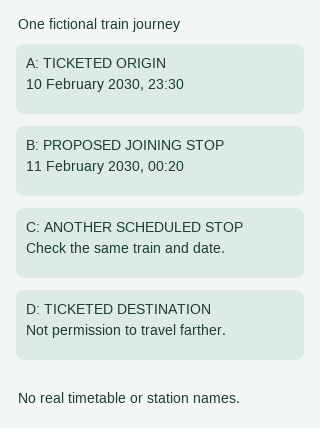
Keep both dates in your question to the railway: “My ticket’s original departure is 10 February; the same service reaches the intended joining stop after midnight on 11 February. How should I board there?” Do not silently edit the ticket date or select another train departing on 11 February merely because the local clock has crossed midnight.
The domestic FAQ gives the date-and-train condition, but this drawing does not resolve how your actual service date appears in a booking channel or station record. Confirm that match before changing your station approach. A screenshot of a timetable is not a completed ticket action.
Do not confuse joining later, stopping over and extending
On a narrow screen, swipe inside the table or focus it and use the right-arrow key.
| Your intended action | Published domestic rule or task | Practical consequence |
|---|---|---|
| Join the same booked train at a later stop | Intermediate boarding permitted for the ticket’s date/train; unused earlier fare not refunded | Verify the actual scheduled stop, date and station process. |
| Take another train instead | A ticket-change task under applicable current conditions | A route map alone does not change the ticket. |
| Leave midway and resume later on a through ticket | The unused section becomes invalid after a voluntary midway stop | Do not plan a sightseeing stop and later resumption on that ticket. |
| Continue beyond the ticketed destination | Request before that destination; railway may permit it if capacity exists, charging the extra segment | Do not assume extension is available or simply remain onboard. |
| Change the final destination before travel | Use the applicable destination-change process | Keep its conditions separate from joining later. |
The onboard FAQ describes separate exceptions where illness or railway responsibility prevents continuing, with an official passenger record and applicable treatment. Those exceptions are not a general tourist stopover option; this guide does not determine responsibility or an individual refund.
For replacing a train or date, use the ticket-change guide. Its timing, capacity, ticket-history and charges remain relevant. “I boarded later” and “I changed my ticket” are different actions.
Rebuild the station approach before changing where you join
Once the railway confirms the intended match, plan the hotel-to-station route for that exact joining station and hour. Keep the full Chinese name if available; an entrance direction within a building is different from a station whose name contains South or West.
Allow for getting there, document checks, security, queues, walking and the current gate instructions. The station-navigation guide covers that sequence. The scheduled departure time is not the last permitted gate-entry time, and no universal number of minutes guarantees boarding.
If you have already missed the train at its earlier stop, do not treat a road journey to the next stop as a reliable rescue plan. First ask railway staff about the actual service, ticket options and feasible alternative. You must still meet the joining station’s checks and cutoff; this article has not verified a chase route or retained seat.
Keep your original order details available privately. If a proposed alternative cannot be confirmed, use the applicable ticket or staffed help process rather than travel to an unverified station on the strength of the diagram.
Three fictional decisions to check
These are route-reading exercises, not real services or tested gate entries.
Case 1
Your ticket is for train X from A to D, but you want to join that same scheduled service at B. Does the source promise a refund for A–B?
Show answer and explanation for case 1
No. The intermediate-boarding passage says the unused earlier fare is not refunded.
Still confirm that B is a scheduled stop of the same dated service and resolve the actual station process.
Case 2
You get off voluntarily at C for sightseeing. Can the unused C–D section automatically take you there on another train later?
Show answer and explanation for case 2
No. The onboard FAQ says the unused through-ticket section becomes invalid.
A stopover is different from joining the original train later or completing a permitted ticket change.
Case 3
You want to remain aboard past D. Can you wait until after D to assume a paid extension?
Show answer and explanation for case 3
No. Request before the ticketed destination and check available capacity.
The railway can refuse continuation when capacity is unavailable. The published rule is not an unconditional upgrade.
Sources and further reading
- 12306: station entry and exitComplete current Chinese Q1–5: original document, station announcements, intermediate boarding on ticket date/train and no unused-segment refund. Public documentary guidance, not an authenticated workflow test.
- 12306: onboard travelComplete current Chinese Q1–5: extension request before ticket destination with capacity, and unused through-ticket section invalid after a voluntary midway stop. Public documentary guidance, not an authenticated workflow test.
- 12306: online ticket purchaseComplete current Chinese Q1–17; only account-conflict/recovery, confirmed order, companion and intermediate-boarding parts used. Conflicting status/hour clauses not generalized. Public documentary guidance, not an authenticated workflow test.