Practical guide
China Child Train Fares: Seats, Sleepers and Discount Floors
Check age and the required seat or berth, then distinguish full execution price from published price. EMU class factors and a 40% published-price threshold can make the child quote different from half an adult fare.
Start with age, accompaniment and the required place
A China child ticket is not always half the adult amount on a search screen. The current Chinese children’s FAQ uses the child’s age on the travel date, then sets different fare rules for train and accommodation categories. On a discounted EMU service, a published-price floor can also change the result.
For an accompanied domestic journey, a child from their sixth birthday until before their fourteenth needs a child discount ticket. From the fourteenth birthday, the full-fare rule applies. Each ticketed adult may bring one child under six free without an independent seat; additional under-six children, or an under-six child needing an independent seat, need child tickets. A free child must still be declared using their valid document.
The child’s ticket date, train and class must match the accompanying adult’s, and the child’s destination must not be beyond the adult’s destination. Use the family train guide for those age, document and declaration checks before comparing money.
Rules checked in the cited public 12306 pages on 9 November 2026. Follow the current instructions for your actual domestic railway journey. No private account, ticket purchase, payment, identity check or travel-day outcome was tested.
Separate the published price from the full execution price
The Chinese source distinguishes 公布票价, the published price, from 全价执行票价, the full execution price for the service and class. They can be different. An adult’s actual discounted quote should not silently become both numbers in your calculation.
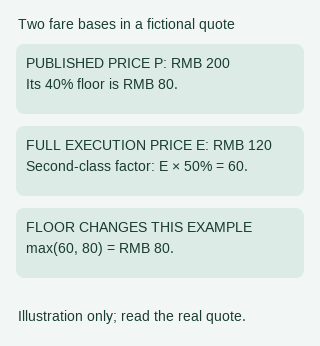
Call the published price P and the full execution price E. The EMU class percentage applies to E. When E is at least 40% of P, the child price has a minimum of 40% of P. When E is below 40% of P, the source says the child price uses E.
Thus, for the stated EMU rule, compare the class calculation with the floor. At or above the threshold, the explanatory expression is max(class factor × E, 0.40 × P); below the threshold, use E. This expresses the cited conditions, not a live price calculator or a railway rounding specification. If your screen does not identify both bases, ask the railway rather than reconstruct a supposed published price from an adult fare.
Use the percentage for the actual EMU class
On a narrow screen, swipe inside the table or focus it and use the right-arrow key.
| EMU class label | Factor before the floor check | What to keep separate |
|---|---|---|
| Second class二等座; first class一等座; multifunction多功能座 | 50% of the full execution price | Not always 50% of the final adult quote after floor conditions. |
| Special class特等座; preferred first优选一等座; business商务座 | 80% of the full execution price | Ordinary first class and preferred first class are distinct labels. |
| EMU sleeper动车组卧铺 | 70% of the full execution price | Do not transfer the conventional independent-berth calculation. |
The published-price threshold still matters after choosing the factor. These are domestic public FAQ categories. Do not apply them to an agency service fee, an unrelated international ticket or a different concession product. Compare the actual displayed class and child quote before paying.
Check seven fictional prices, including the threshold boundary
Every amount in this table is invented. Each row assumes P is RMB 200 for the corresponding EMU class; the examples do not assert that different real classes share a published price. The numbers avoid an unsupported rounding rule.
On a narrow screen, swipe inside the table or focus it and use the right-arrow key.
| Class and execution priceE | Class calculation | Floor condition and child result |
|---|---|---|
| Second class, E 200 | 0.50×200=100 | E≥80; max(100, 80)=RMB 100. |
| Second class, E 120 | 0.50×120=60 | E≥80; max(60, 80)=RMB 80. |
| Second class, E 80 | 0.50×80=40 | E equals the threshold; max(40, 80)=RMB 80. |
| Second class, E 70 | The below-threshold rule applies | E<80; use E=RMB 70. |
| Business, E 200 | 0.80×200=160 | E≥80; max(160, 80)=RMB 160. |
| EMU sleeper, E 200 | 0.70×200=140 | E≥80; max(140, 80)=RMB 140. |
| EMU sleeper, E 100 | 0.70×100=70 | E≥80; max(70, 80)=RMB 80. |
The E 120 example explains why “half the adult price” can disappoint: half of 120 is 60, but the stated floor is 80. At E 70, applying that same 80 floor would miss the source’s separate below-threshold branch. Keep the branch condition with the arithmetic instead of retaining one percentage for every quote.
Read a conventional sleeper quote by its components
The conventional-train rule is different. The FAQ describes the relevant passenger fare and additional published components at 50%. It then says a free child or child-discount passenger using an independent berth is charged the full berth component; where air conditioning applies, it also specifies the half-price air-conditioning component. Do not replace that explanation with “every hard or soft sleeper is half price.”
For a fictional component check, a published berth component of RMB 140 remains RMB 140 under the full-berth instruction; it does not become RMB 70. A separately applicable published air-conditioning component of RMB 20 has a half-price value of RMB 10. These are isolated invented components, not a complete ticket quote. Ask for the actual breakdown so you neither omit a component nor add the same component twice.
Use the hard- and soft-sleeper comparison for layout and berth-level questions. A correct price calculation does not secure a lower berth, neighboring allocations or a private compartment. For a family comparison, keep the same date, stations, train and class, then list each child’s status, independent place, actual fare and any separately disclosed agency fee.
Three explained checks before comparing family quotes
These are fictional reading exercises, not quoted railway prices.
Case 1
With published price 200 and second-class execution price 120, is 60 the final child price under the stated rules?
Show answer and explanation for case 1
No. The illustrated result is RMB 80.
The 50% calculation gives 60, but E 120 is at least 40% of P 200, so the 80 floor applies.
Case 2
If that execution price is 70, must the child still pay the 80 floor?
Show answer and explanation for case 2
No. The below-threshold branch uses E: RMB 70.
70 is below 40% of 200. The source gives a separate rule for this condition.
Case 3
Does selecting preferred first class mean using the ordinary first-class 50% factor?
Show answer and explanation for case 3
No. Read the exact class label.
The FAQ puts优选一等座 with the 80% group, while一等座 is in the 50% group. Check the floor and actual quote as well.
Sources and further reading
- 12306: children and child faresComplete current Chinese Q1–4: age on travel date, free-child declaration, own document, class factors, published/execution price floor, and conventional independent-berth components. Public documentary guidance, not an authenticated workflow test.