Practical guide
Pudong Airport: Maglev, Metro Line 2 or Airport Link?
Choose the rail service by its real endpoint and your remaining transfers. Compare Maglev, Metro Line 2 and Airport Link without treating segment speed or dated fares as a hotel-arrival promise.
Start with the hotel, airport or station you need
For a Pudong arrival, Maglev, Metro Line 2 and Airport Link solve different route problems. The fastest-looking train segment is not automatically the best way to your hotel. Write the complete destination first: hotel entrance and district, Hongqiao flight terminal, or the full name on an onward rail ticket.
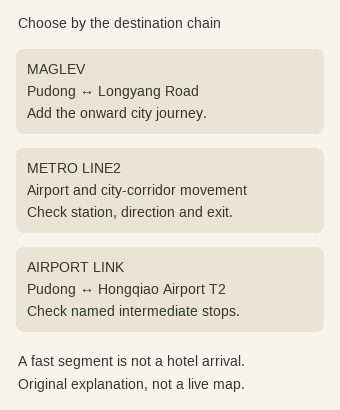
Maglev connects Pudong with Longyang Road. Metro Line 2 serves the Pudong terminal station and the city corridor; the municipal airport guide gives People’s Square as a downtown example. Airport Link connects Pudong T1&T2 with Hongqiao Airport T2 through its named intermediate stations. Compare that chain with your destination before comparing train speed.
For an airport-to-airport movement, use the terminal-specific Airport Link guide. For a city stay, keep the last station and the hotel-side walk in the decision. A route ending at the correct district can still be inconvenient with stairs, a long exit corridor or bags.
Compare the actual endpoint and the remaining work
On a phone, swipe within the table. Keyboard users can focus the table and use the arrow keys.
| Service | Published connection | What to resolve for your actual trip |
|---|---|---|
| Maglev | Pudong Airport to Longyang Road. | Onward service, ticket, direction, destination exit and final hotel walk. Longyang Road is not every visitor’s destination. |
| Metro Line 2 | Pudong T1&T2; the authority also describes the connection to Hongqiao Airport T2. | Actual city stop, operating window, luggage handling and final entrance. A long direct ride can still be simpler than another transfer. |
| Airport Link | Pudong T1&T2 to Hongqiao Airport T2 and seven named stations. | Whether an endpoint or intermediate stop fits the destination; extra terminal/station access and any out-of-station interchange. |
The municipal airport page describes transferring from Maglev at Longyang Road to Metro 2. It does not establish the exact transfer walk, a single combined fare or the operating time for your onward direction. Investigate those details for your actual arrival rather than count only the Maglev ride.
Airport Link’s city connections also need careful interpretation. The municipal description says Metro 9 at Zhongchun Road is an in-station transfer. It describes connections at Hongqiao T2, Jinghong Road and Pudong as out-of-station. That difference can add entrance and ticketing work even when the lines look adjacent on a route diagram.
Count the transfers you will actually make
Compare routes in the same units: terminal-to-destination, not one train against another. Write each boarding, alighting, transfer and final walk. An extra train can shorten a rail segment while increasing waiting, stairs, ticket handling or navigation. The sources here do not measure those tasks for your trip.
With light bags and a destination near an appropriate Metro 2 station, a direct metro route can be easier to follow. If you specifically want to ride Maglev and can manage the Longyang Road connection, the extra step may fit your plan. If the destination is Hongqiao Airport T2, Airport Link’s endpoint is directly relevant. These are editorial route comparisons, conditional on actual operating services.
Check physical access for your own needs. A line listing does not prove that every lift is operating or that a suitcase, stroller or mobility aid can follow the proposed interchange unaided. Obtain the current accessible route when necessary. For Airport Link bags, the separate luggage check explains the published limits.
Compare fare components without turning old figures into live quotes
The airport authority Maglev page, updated 17 March 2025, lists regular fares of RMB 50 one-way and RMB 80 round-trip. The municipal Airport Link guide, updated 31 March 2026, lists a RMB 4 starting price and RMB 26 full journey. The municipal airport page updated 4 June 2026 gives an approximate RMB 7 Metro 2 fare for its Pudong-to-People’s-Square example. These are differently dated figures for different products and route scopes.
Do not combine them into a supposed current hotel fare. A Maglev-to-metro route needs its onward fare; an Airport Link itinerary may need another service; an approximate Metro 2 example is not every city journey. The Shanghai transportation hub also reports a 2026 fare consultation. A consultation notice does not prove that a proposed tariff took effect. Confirm the actual ticket price and conditions before payment.
For simple arithmetic only, two separately purchased RMB 50 rides would total RMB 100, while the listed RMB 80 round-trip product is RMB 20 less. That is not a recommendation to buy the return ticket: the cited page does not state its validity window or all eligibility conditions. Check those terms against your departure date. No boarding-pass discount or combined-ticket entitlement is assumed here.
Actual route and date: ___
First service / exact product / current quote: ___
Onward service / current quote: ___
Final leg / current quote if needed: ___
Return-ticket validity and conditions: ___
Total of confirmed components: ___
Unconfirmed component: ___
Try three fictional destination choices
These are hypothetical route choices, not real hotel journeys or measured comparisons.
Case 1
A fictional hotel can be reached from an appropriate Metro 2 stop. Must Maglev be quicker to the hotel because its train is faster?
Show answer and explanation for case 1
No. Compare the complete route including the Longyang Road transfer.
A faster rail segment does not measure waiting, another ticket, the interchange or the final walk. A direct route may fit better.
Case 2
An imaginary onward flight uses Hongqiao T2. Which published rail endpoint is specifically relevant?
Show answer and explanation for case 2
Airport Link’s Hongqiao Airport Terminal 2 endpoint.
Confirm the actual operating window and terminal-door route. The train connection does not establish a flight connection time.
Case 3
A traveler sees the stop name Shanghai International Resort on Airport Link. Does that guarantee direct admission to an attraction?
Show answer and explanation for case 3
No. A station name is not an entrance, reservation or operating-hours instruction.
Check the actual venue, access route and booking requirements before choosing that stop for an attraction visit.
Save the route you selected and one usable alternative
After choosing a service, keep one short route note with the terminal, direction, named interchange, destination exit and Chinese address. Save it in a form you can open if mobile data is unavailable. Add the current service window and the source date rather than copy an old “last train” into a permanent note.
The Airport Link timetable descriptions consulted here disagree, and the Maglev figures are explicitly dated. Confirm the day’s actual service before entering a route that depends on the last departure. A scheduled landing time does not say when baggage and entry steps will finish.
If the rail chain no longer fits, reassess the whole destination. A late-night bus can serve a useful city stop but requires its own final leg; an official taxi rank or booked pickup needs an actual destination and payment plan. The night-bus explanation helps you evaluate that option instead of assuming every bus reaches your lodging.
A good comparison ends with a chosen route and a reason: fewer transfers with bags, the correct airport endpoint, or a deliberate Maglev ride with a known onward leg. It does not require keeping all three rail services in play until you leave the arrivals hall.
Sources and further reading
- Shanghai municipal guide: How to take Airport Link LineUpdated 31 March 2026. Complete public text consulted 10 November 2026; image-only charts not used. Published conditions are not a live fare, timetable or travel guarantee.
- Shanghai Airport Authority: Airport Link LineUpdated 22 June 2026; its direction/headway text conflicts with the municipal description. Complete public text consulted 10 November 2026; image-only charts not used. Published conditions are not a live fare, timetable or travel guarantee.
- Shanghai Airport Authority: MaglevUpdated 17 March 2025. Complete public text consulted 10 November 2026; image-only charts not used. Published conditions are not a live fare, timetable or travel guarantee.
- Shanghai Airport Authority: MetroTerminal entries dated 13 April 2024/17 March 2025. Complete public text consulted 10 November 2026; image-only charts not used. Published conditions are not a live fare, timetable or travel guarantee.
- Shanghai municipal guide: Transportation at Shanghai airportsUpdated 4 June 2026. Complete public text consulted 10 November 2026; image-only charts not used. Published conditions are not a live fare, timetable or travel guarantee.