Practical guide
What Luggage Fits Shanghai’s Airport Link Line?
Check the published weight instruction, cubic volume and dimension sum separately. Work through fictional bags and keep airline allowances, measurement uncertainty and actual boarding decisions distinct.
Keep the rail conditions separate from an airline allowance
A suitcase that meets an airline’s baggage allowance does not automatically meet Shanghai Airport Link’s published luggage conditions. The municipal guide, updated 31 March 2026, tells passengers to keep items under 23 kg, says each piece must occupy no more than 0.2 cubic meters, and limits the sum of length, width and height to 1.8 meters.
Check all three conditions. Weight, volume and the dimension sum answer different questions. A light but very long object can exceed the dimension sum; a compact but heavy case can fail the weight instruction. Do not replace the source’s strict “under 23 kg” with the airline shorthand “a 23 kg bag”.
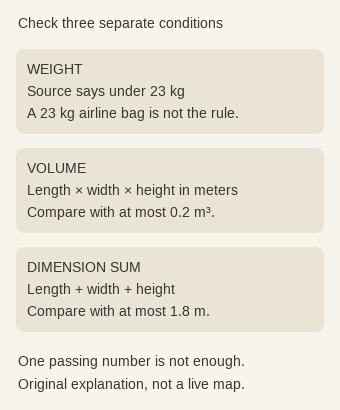
This guide explains those published measurements. It does not establish a per-person aggregate allowance, permission for unusual items, airline restrictions or a staff decision at the station. Confirm current operator instructions for your actual items, especially anything fragile, irregular, hazardous or difficult to handle.
Calculate volume and the dimension sum in consistent units
Measure the actual outer dimensions of the packed piece. Include protruding wheels, handles or attachments in your measurement note rather than relying on a suitcase’s marketing size. The cited municipal page does not prescribe a measurement instrument or rounding tolerance; do not invent one at a boundary.
For a rectangular measurement example, convert centimeters to meters before multiplying. A hypothetical case measuring 75 × 50 × 30 cm has dimensions 0.75 × 0.50 × 0.30 m. Their product is 0.1125 m³. The dimension sum is a different calculation: 75 + 50 + 30 = 155 cm, or 1.55 m.
The volume threshold of 0.2 m³ equals 200,000 cm³. The sum threshold of 1.8 m equals 180 cm. If you use centimeters throughout, compare the product with 200,000 cm³ and the sum with 180 cm. Never compare a centimeter product directly with the decimal 0.2, or add the three measurements and call the result a volume.
For a non-rectangular item, a rectangular calculation is only an explanatory model. Obtain the operator’s applicable measurement method rather than claim that an estimated bounding box settles admission. If your scale reading or dimensions are uncertain, record the uncertainty and seek clarification; rounding a borderline value down is not a rule.
Check four invented bags, including the strict weight boundary
All four bags below are fictional rectangular examples with assumed exact outer measurements and weight readings. “Within the listed conditions” means the arithmetic fits the cited limits; it is not an actual boarding decision or proof that every other requirement is met.
On a phone, swipe within the table. Keyboard users can focus the table and use the arrow keys.
| Assumed bag | Volume and dimension sum | Result for the listed measurements |
|---|---|---|
| A: 75×50×30 cm; 22 kg | 0.1125 m³; 155 cm = 1.55 m. | Under 23 kg; volume and sum within their limits. All three listed measurement checks fit. |
| B: 75×50×30 cm; 23 kg | 0.1125 m³; 1.55 m. | Volume and sum fit, but 23 kg is not under 23 kg. Do not claim a pass from the airline label. |
| C: 100×50×40 cm; 22 kg | 0.2000 m³; 190 cm = 1.90 m. | Volume is at its stated maximum, but the dimension sum exceeds 1.8 m. |
| D: 90×50×40 cm; 22 kg | 0.1800 m³; 180 cm = 1.80 m. | Within the stated volume limit and exactly at the dimension-sum limit; weight is under 23 kg. Other requirements remain separate. |
Bag C shows why passing a volume check does not replace the sum check. Bag B shows why a label reading “23 kg checked baggage” is not the same condition as “under 23 kg”. Bag D illustrates the inclusive dimension boundary, without granting any measurement tolerance.
The examples avoid an invented conclusion about permitted total luggage across several pieces. List each actual piece and ask the operator about the relevant passenger allowance or unusual item if needed. The source’s three measurement statements should not become a broader entitlement it does not explain.
Consider the storage space and your actual handling needs
The same municipal guide describes lower luggage racks for larger items and upper racks for smaller items. Use the available arrangement as directed and keep belongings clean and considerately stored. The description does not reserve a rack for you or guarantee free space on a particular train.
A measured bag can still be awkward through a station, at an interchange or during a terminal walk. Consider whether you can control and lift it as required, whether you are also managing children or another item, and whether the actual route has assistance or a suitable accessible path. These handling needs are not answered by the three measurements.
Keep the destination chain with the bag check. The Airport Link terminal guide distinguishes its Hongqiao T2 endpoint from a separate T1 or railway-station leg. Each additional leg may have its own luggage and access conditions.
If the real item exceeds a stated condition or remains unconfirmed, compare a suitable alternative and check that alternative’s capacity and rules. A car, bus, storage service or airline arrangement does not inherit permission from the rail calculation. Confirm an actual provider’s instructions before relying on it.
Try three fictional measurement checks
These are reading exercises with invented bags, not results from a travel test.
Case 1
An imaginary suitcase is exactly 23 kg and its dimensions fit. Does it meet the cited weight wording?
Show answer and explanation for case 1
No. Exactly 23 kg is not under 23 kg.
The source uses a strict weight instruction. Do not replace it with a different airline allowance or an invented tolerance.
Case 2
A fictional 100×50×40 cm case is 22 kg. Its volume is exactly 0.2 m³. Does that complete the check?
Show answer and explanation for case 2
No. Its dimension sum is 1.90 m, above 1.8 m.
Calculate the product and the sum separately: 1.00×0.50×0.40=0.20 m³; 1.00+0.50+0.40=1.90 m.
Case 3
A fictional 90×50×40 cm bag at 22 kg meets the three listed measurements. Is boarding therefore guaranteed?
Show answer and explanation for case 3
No. The arithmetic addresses only the stated measurement conditions.
Current instructions, unusual-item restrictions, actual measurement, access and staff directions still need to be satisfied.
Save a measured-bag note before choosing the transfer
Travel date and service: ___
Piece description: ___
Packed weight and measurement uncertainty: ___ kg
Outer length / width / height: ___ / ___ / ___ cm
Volume: ___ cm³ ÷ 1,000,000 = ___ m³
Dimension sum: ___ cm ÷ 100 = ___ m
Published conditions and source date: ___
Unusual-item or aggregate-allowance question: ___
Operator clarification, if needed: ___
Alternative with confirmed capacity: ___
Keep the record short enough to use with the actual bag. It is helpful for comparing conditions and asking a precise question; it is not a permit. If your itinerary changes service, recheck the next operator rather than carry the Airport Link measurements into a metro, coach or flight rule.
For route selection, return to the Pudong rail comparison. A workable transfer combines the correct endpoint, current service, manageable luggage and a usable final leg. Passing one calculation does not decide all four.
Sources and further reading
- Shanghai municipal guide: How to take Airport Link LineUpdated 31 March 2026. Complete public text consulted 10 November 2026; image-only charts not used. Published conditions are not a live fare, timetable or travel guarantee.