Practical guide
Chinese Railway Help Phrases for a Wrong Station or Missed Train
Show the complete station name and dated train, ask one precise question, and confirm the actual answer before moving. Nine bilingual phrases, two check tables, an offline card and seven scenarios help you distinguish navigation, boarding status and ticket options.
Start with the station, train and current boarding status
If you think you reached the wrong station or missed your train, find an appropriate railway staffed help point promptly. Show the actual confirmed journey and describe what happened. Start with facts: where you are, the full departure station, date, train number and current time.
Keep three questions separate. Are you in the correct building? Is boarding for the booked train still permitted? If that journey is no longer usable, what procedure applies to this ticket? A useful sentence cannot answer those questions by itself.
The Chinese phrases below are original language aids, with pinyin and English meanings. They are questions to show or read to staff, rather than railway policy quotations or promises of a seat, refund, free change or successful transfer. Replace brackets with the exact information from the booking.
Do not cross a closed gate, enter a staff-only passage or board another train on the assumption that the destination is close enough. Follow current signs and staff instructions while the actual options are checked.
Prepare the information without exposing the whole booking
Keep your required identity document accessible. For railway e-tickets, the 12306 English FAQ says to retain ticket information and use the valid identity document used to purchase the ticket for station entry, exit and boarding. It also says an itinerary sheet or reimbursement receipt cannot be used as a ticket.
Your own question card is a navigation and communication aid. Keep the confirmed booking available privately for railway staff or the issuing channel when needed. A screenshot can help identify the journey; it is not a replacement passport or proof that another service has been booked.
| Information | Copy from the actual journey | Why it matters |
|---|---|---|
| Departure station | Complete name, including any direction or other ending | Separates a wrong building from a wrong entrance |
| Travel date and train | Dated service and train number | Separates this booking from a similar destination |
| Scheduled departure | Time on the actual booking | Does not establish that boarding is still open |
| Current location | Full station name and the help point you reached | Lets staff address the situation you are in now |
| Connecting train, if relevant | Its own date, train and full station pair | Makes two affected journeys visible |
| Private documents and reference | Keep available for the appropriate official check | Leave sensitive details off a broadly shared direction card |
If the order was issued through an agency, keep its contact and booking reference available too. Identify whether you are asking the railway about boarding or the issuing channel about an order or transaction. A booking request still awaiting confirmation needs a status check of its own.
Card one: ask about the wrong station and the real route
1. 我可能走错车站了。我的出发站是【完整车站名】。请问这里是哪个车站?
Wǒ kěnéng zǒu cuò chēzhàn le. Wǒ de chūfāzhàn shì [完整车站名]. Qǐngwèn zhèlǐ shì nǎge chēzhàn?
I may be at the wrong station. My departure station is [full station name]. Which station is this?

2. 从这里去【完整车站名】,应该怎么走?
Cóng zhèlǐ qù [完整车站名], yīnggāi zěnme zǒu?
How should I get from here to [full station name]?

3. 这趟车几点停止检票?
Zhè tàng chē jǐ diǎn tíngzhǐ jiǎnpiào?
What time does this train stop checking tickets?
In the first sentence, keep the complete Chinese departure-station name. For example, 北京南 and 北京西 are distinct station names; do not shorten either to 北京 when showing the booked departure. An entrance described as north or south is a separate detail within a station.
Use question two after the building is identified. Ask for a practical route to the correct station, including the entrance or drop-off point and relevant transport arrangements. This article has no tested city-to-city-station travel times or guarantee that a cross-town journey can recover the departure.
Question three asks about the boarding cutoff, not just the train's scheduled departure. The official FAQ directs passengers to station announcements for the advance time when ticket checks stop. Reaching a station before departure does not establish that boarding remains open.
If the correct train is no longer reachable, tell staff that situation rather than repeatedly searching for its platform in the wrong building. Keep any onward commitment visible when considering the alternative.
Card two: ask which ticket procedure applies now
4. 我没有赶上这趟车。请问这张票现在还能改签吗?
Wǒ méiyǒu gǎnshàng zhè tàng chē. Qǐngwèn zhè zhāng piào xiànzài hái néng gǎiqiān ma?
I did not catch this train. Can this ticket still be changed now?

5. 请问改签窗口在哪里?
Qǐngwèn gǎiqiān chuāngkǒu zài nǎlǐ?
Where is the ticket-change counter?

6. 如果可以改签,请问哪些车次还有票?需要支付多少费用?
Rúguǒ kěyǐ gǎiqiān, qǐngwèn nǎxiē chēcì hái yǒu piào? Xūyào zhīfù duōshao fèiyòng?
If a change is possible, which trains still have tickets? How much needs to be paid?
“Can this ticket still be changed now?” leaves eligibility open. It does not assert that the ticket is changeable, that a free change applies, or that the next train has a place. Point to the specific dated booking when asking.
The 12306 English FAQ calls a ticket change “endorsement” and describes changes to travel date, train number or seat/berth subject to capacity and applicable conditions. It also distinguishes change of destination from ordinary ticket changes. Ask about the permitted action rather than choosing a label because it sounds similar.
The public official order page and FAQ were checked on 1 November 2026. They discuss after-departure changes, once-only change conditions, fees and exceptions. Some public English sections retain older wording alongside updates. For the actual ticket, confirm the current deadline, permitted replacement and charges in 12306 or at the designated station counter.
A missed train does not automatically become a refund request with an assured result. If you want to cancel, ask what refund process applies now and distinguish that answer from a change offer. Do not infer that an after-departure change leaves the same later refund options.
Before agreeing to a proposed alternative, check the full replacement journey and the total amount to pay. Separate any fare difference and railway change charge from an agency's service fee. No transaction is made by showing this card.
Card three: documents, a delayed connection and the answer
7. 我用这本护照买票。请问需要在哪里核验?
Wǒ yòng zhè běn hùzhào mǎi piào. Qǐngwèn xūyào zài nǎlǐ héyàn?
I bought the ticket using this passport. Where does it need to be checked?

8. 前一趟车晚点了,我没有赶上下一趟车。请问应该怎样处理这两张票?
Qián yī tàng chē wǎndiǎn le, wǒ méiyǒu gǎnshàng xià yī tàng chē. Qǐngwèn yīnggāi zěnyàng chǔlǐ zhè liǎng zhāng piào?
My previous train was delayed and I did not catch the next train. How should these two tickets be handled?

9. 请把新的车次、日期、出发站和费用写下来。
Qǐng bǎ xīn de chēcì, rìqī, chūfāzhàn hé fèiyòng xiě xiàlái.
Please write down the new train number, date, departure station and charges.
Use the passport question when the document check or appropriate lane is unclear. Show the original required document directly to authorised staff as needed. Do not assume that every automated gate handles a foreign passport in the same way.
The delay sentence keeps both trains in the discussion. Show their dates, stations and identifiers. The official FAQ describes staff arrangements where railway responsibility prevents travel as booked; that is different from a blanket promise about every late connection. Ask how the actual circumstances and both tickets should be handled.
The last sentence requests a written answer you can compare with the new booking. If you cannot read it confidently, ask staff or the official channel to explain the station, date, train and charges before proceeding. A translation app can assist communication, but its output is not proof of eligibility or a completed change.
Keep a private note of the help point, time and advice received. Leave unclear items marked unknown. Do not turn a suggested train number into “confirmed” until the applicable booking channel reports the completed result.
Confirm the result before heading to another gate
| Check | Question to settle | Record the actual result |
|---|---|---|
| Order status | Is the change completed or only suggested? | Confirmed status or unresolved action |
| New journey | What are the full departure station, date and train? | Copy all three from the new booking |
| Charges | What fare difference and other charges apply? | Actual amount and issuing channel |
| Boarding | Which current gate and cutoff apply? | Current display or staffed instructions |
| Onward plan | What changes after the revised arrival? | Transport, accommodation or connecting journey |
Keep the old and new journey details distinct. Recheck the replacement arrival date too, especially for overnight services. If a different station is involved, rebuild the station approach; the old route to the first building may no longer be useful.
Follow the current gate display for the confirmed replacement train, then find its carriage and allocated seat or berth. A gate is not a carriage number. A staff suggestion about a later train is not a new seat assignment.
If there is no workable rail alternative, ask for the applicable ticket options and reconsider the itinerary. Contact affected accommodation or onward providers yourself when needed. Do not rely on an unverified last metro, an assumed available taxi or an unconfirmed next-day booking.
Save a bilingual copy and keep a staffed fallback
Open the nine bilingual railway phrases and private result record. The text file includes Chinese, tone-marked pinyin, English meanings, blank journey fields and the seven case explanations below. Save the useful portion before travel if you want to consult it without mobile data.
Show one question at a time. Read the English line first to check that it says what you mean; use the Chinese line for the request. The bracketed station name should come from your actual booking, rather than a station guessed from the city.
A Shanghai municipal announcement dated 7 November 2025 described a trial English indoor-navigation service at Hongqiao for transport pickup points and amenities. That historical announcement is not proof that a service is available now, a rail-to-rail passage is permitted, or a missed train can be recovered. Current signs and railway staff remain the appropriate route for these questions.
For prevention, use the separate complete-station-name comparison before leaving your accommodation. For two trains, use the same-station route and backup checklist. This card addresses the help conversation once something has gone wrong.
Read the response map and test seven situations
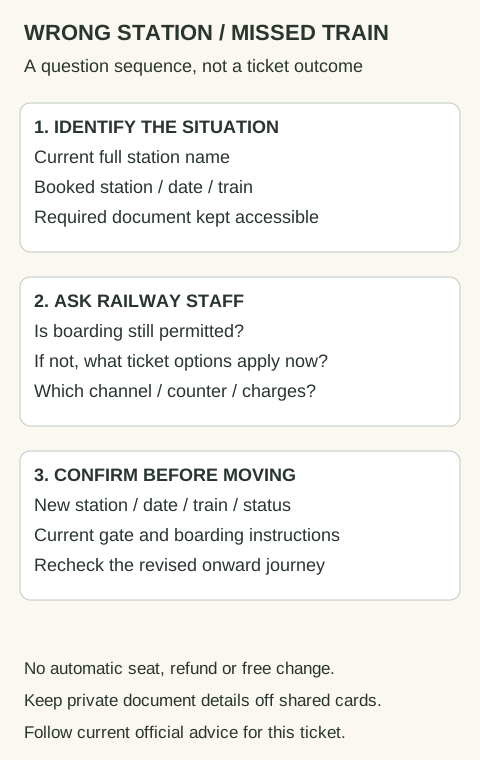
Identify the next question before opening each explanation. Every scenario is fictional; no train, transfer or ticket transaction was tested.
Case 1
Your booking says 北京南, but the building you reached is 北京西. Both are in Beijing. Should you keep looking for the booked gate here?
Show answer and explanation for case 1
First confirm the full station names with staff and ask about your actual options.
A shared city does not establish the same departure station. Show the confirmed station and train; do not assume that train serves the building you reached.
Case 2
A fictional train departs at 14:20, but its invented boarding cutoff is 14:10. It is now 14:12. Can the departure time alone establish that boarding remains open?
Show answer and explanation for case 2
No. Ask staff about the current boarding status for that exact train.
The times are fictional. Actual ticket checks stop before departure at the locally announced time; the timetable clock is not permission to pass a closed gate.
Case 3
A screen lists a later train to your destination. Is your original ticket automatically valid for it?
Show answer and explanation for case 3
No. Check the applicable change or new-ticket process and confirmed result.
A displayed service is not a transferred booking or allocated place. Exact stations, dates, availability and ticket conditions remain separate checks.
Case 4
You missed your train after reaching the wrong station. Does a phrase asking about a change guarantee a free replacement?
Show answer and explanation for case 4
No. It requests an assessment of this ticket now.
The official FAQ makes changes subject to conditions and capacity. Charges, fare difference and available alternatives must be checked for the actual booking.
Case 5
Your first train was delayed and you missed a separately booked onward train. What information belongs in the help request?
Show answer and explanation for case 5
Show both dated train journeys and explain the delay and missed onward service.
Ask how both tickets should be handled. Do not decide railway responsibility or promise a particular replacement yourself; let the applicable railway process address the circumstances.
Case 6
Someone helping with directions asks you to post your passport page and full order reference in a public group. Are those needed on the navigation card?
Show answer and explanation for case 6
Keep the shared navigation copy to the station and journey details needed for directions.
Show required identity documents and private booking information directly to the appropriate official channel when needed. A homemade card does not replace the original document.
Case 7
A suggested replacement departs at 00:25. Your earlier train was dated the previous evening. What should you confirm before acting?
Show answer and explanation for case 7
The full new departure date, station, train and confirmed booking status.
A clock time shortly after midnight belongs to a calendar date. Also check your onward route and accommodation; do not treat a suggestion as a completed ticket change.
Sources and further reading
- China Railway 12306: English frequently asked questionsOriginal-document requirements, station-announced boarding cutoff, capacity and conditions for changes, refund distinctions and railway-responsibility arrangements. Public sections retain some older wording; actual ticket instructions must be checked.
- China Railway 12306: English ticket-order pagePublic order status and current ticket-action context. No logged-in order, payment or transaction tested; the template does not establish this reader’s eligibility.
- Shanghai Municipal Government: November 2025 Hongqiao English navigation announcementHistorical trial covering transport pickup points and amenities, not current service availability or railway ticket/transfer eligibility.
Read the ticket action before choosing the next train
If you intend to cancel, check refund clocks and ordinary fee bands. If you intend to replace the journey, separate the change charge from fare payment. Use the actual order and appropriate issuing channel.